
Germany's Synthetic Detergent Invention
The Chemists Behind Synthetic Detergents
The Detergent Revolution
The development of synthetic detergents was not the result of a single invention, but the convergence of applied detergent chemistry and advances in large-scale synthetic materials. In Germany, this work was shaped by both necessity and innovation. Heinrich Gottlob Bertsch played a direct role in creating the first fully synthetic detergents, while Fritz Hofmann’s earlier advances in synthetic chemistry and industrial infrastructure helped make such materials technically and economically possible. Together, their contributions reflect how modern detergents emerged from a broader chemical transformation rather than from consumer product design alone.
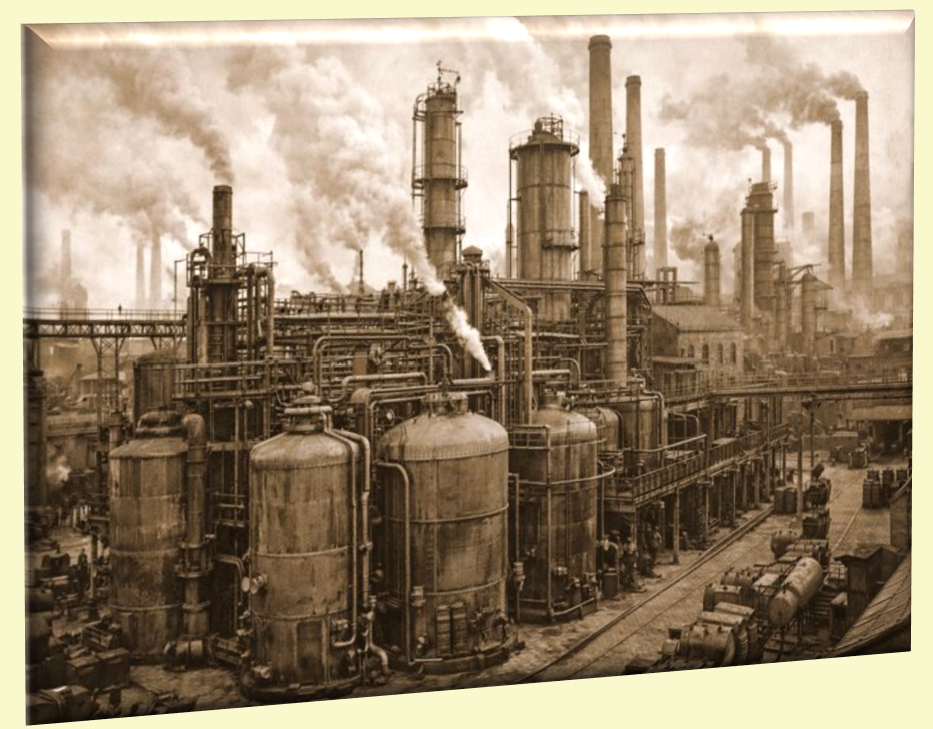
1840’s Petrochemical plants & pollution
Image AI generated
Heinrich Gottlob Bertsch — what he contributed (Germany, synthetic detergents)
Bertsch is widely credited as the inventor of the world’s first fully synthetic detergent.
In 1932, while working at H. Th. Böhme AG (Chemnitz), he developed FEWA, described as the first mild detergent and first fully synthetic detergent.
FEWA’s success helped drive major industrial adoption and later corporate moves (Henkel’s involvement with Böhme is commonly noted in summaries of his career).
Fritz Hofmann — what he contributed (Germany, but not detergents)
Hofmann (at Bayer/Elberfeld) led work that produced early synthetic rubber (notably via polymerizing isoprene) and is often credited with the first synthetic rubber patent (1909).
So, if a source says “Fritz Hofmann invented the first synthetic detergent,” that’s very likely a misattribution (Hofmann’s well-documented legacy is rubber/polymer chemistry, not surfactant detergents).
The Wartime Problem Germany Faced
By the outbreak of World War I, Germany was largely cut off from animal fats, vegetable oils, and colonial oil crops such as coconut and palm—key raw materials required for traditional soap production. Because soap is fundamentally produced from fats combined with alkali, these shortages due to blockades caused soap manufacturing to falter. In response, German chemists were compelled to pursue alternative approaches to cleaning chemistry, turning to coal, petroleum, and lignite as raw materials. This shift led to the development of synthetic surfactants that no longer relied on triglycerides, creating the chemical landscape in which both direct detergent innovation and broader synthetic chemistry advances emerged.
By World War I, Germany was largely cut off from:

Image AI generated
Animal fats
Vegetable oils
Colonial oil crops (coconut, palm, etc.)
Traditional soap = fat + alkali
So when fats disappeared, soap production collapsed.
This forced German chemists to pursue:
Coal-based chemistry
Petroleum and lignite derivatives
Synthetic surfactants that did not require triglycerides
That’s the umbrella under which both men appear, but in very different roles.
The Development of Synthetic Detergents (Bertsch)
Heinrich Gottlob Bertsch was a central figure in the development of synthetic detergents. During the interwar period, building directly on the material shortages experienced in World War I, Bertsch focused on creating cleaning agents that did not rely on fats or oils. His work led to the development of alkyl sulfate–based detergents, which represented a fundamental shift away from traditional soap chemistry. In 1932, he introduced FEWA, widely recognized as the first fully synthetic detergent. Unlike soap, FEWA was effective in hard water and functioned independently of triglycerides, making it uniquely suited to the material constraints of the time.
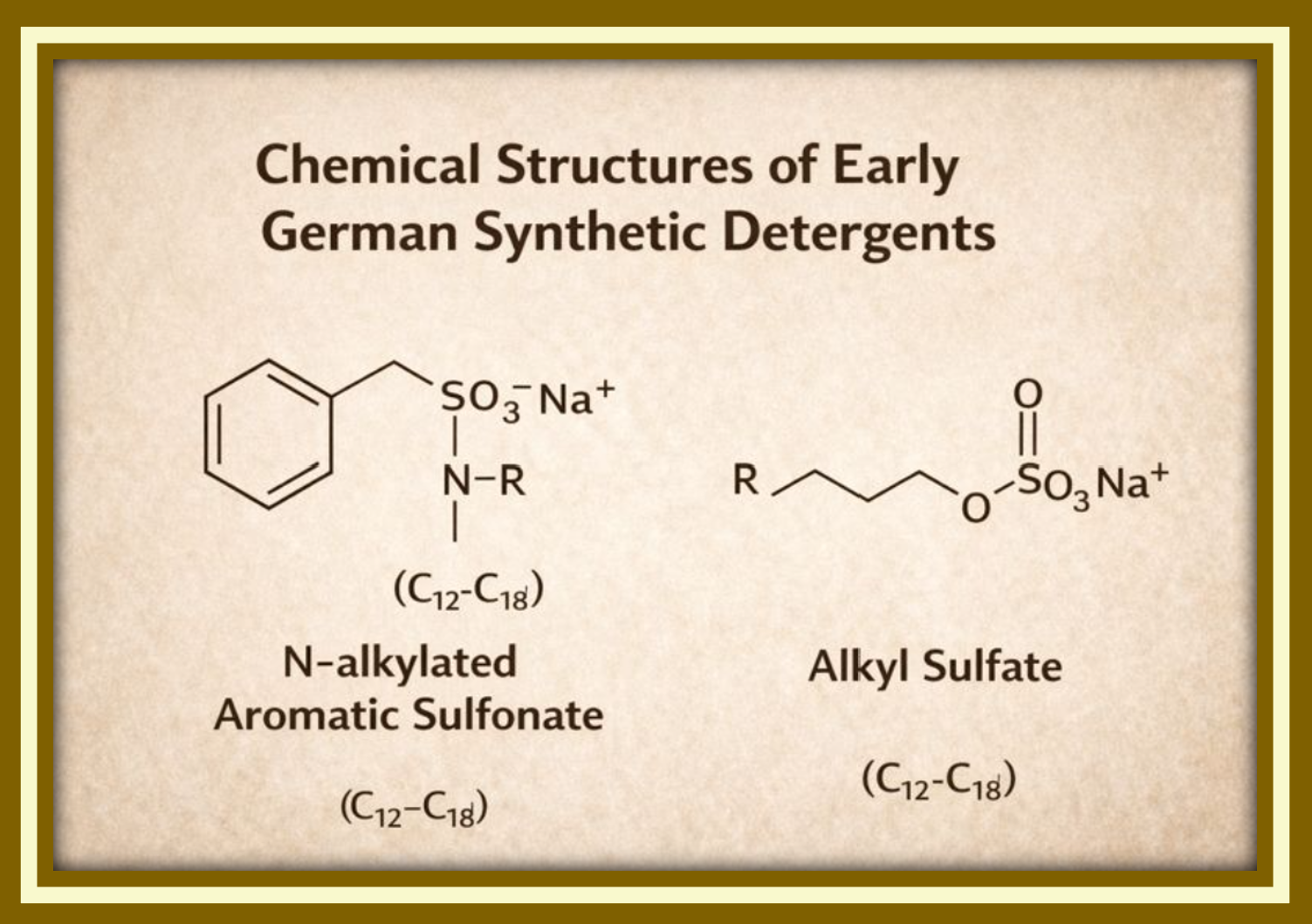
Image AI generated
The significance of Bertsch’s work became especially clear during World War II. FEWA and related detergent chemistry allowed textiles to be washed without soap, helping maintain hygiene despite severe fat rationing. This innovation aligned closely with Germany’s wartime autarky policies, which emphasized self-sufficiency and reduced reliance on imported resources. The underlying chemistry developed by Bertsch later fed directly into large-scale detergent programs under companies such as Henkel, solidifying synthetic detergents as a permanent replacement rather than a temporary substitute. In practical terms, Bertsch solved the cleaning problem itself.
The Chemical Foundations of Synthetic Materials (Hofmann)
Fritz Hofmann did not develop detergents directly, but his contributions were critical to the broader chemical framework that made synthetic detergents possible. As a pioneer in synthetic rubber and polymer chemistry, Hofmann advanced methods for producing complex organic materials from coal- and petroleum-derived feedstocks. His work helped establish the industrial processes, reaction pathways, and large-scale chemical infrastructure that later detergent chemists depended on.
By demonstrating that essential materials could be synthesized without relying on natural biological sources, Hofmann’s research helped shift German chemistry away from fat- and oil-based inputs altogether. This transformation enabled the mass production of synthetic surfactants and other materials under wartime conditions. While Bertsch addressed the immediate problem of cleaning without soap, Hofmann’s earlier advances provided the industrial and chemical foundation that made such solutions technically and economically feasible.
The move away from soap was not an improvement of an old formula, but the creation of an entirely new chemical solution to a problem soap could no longer solve.
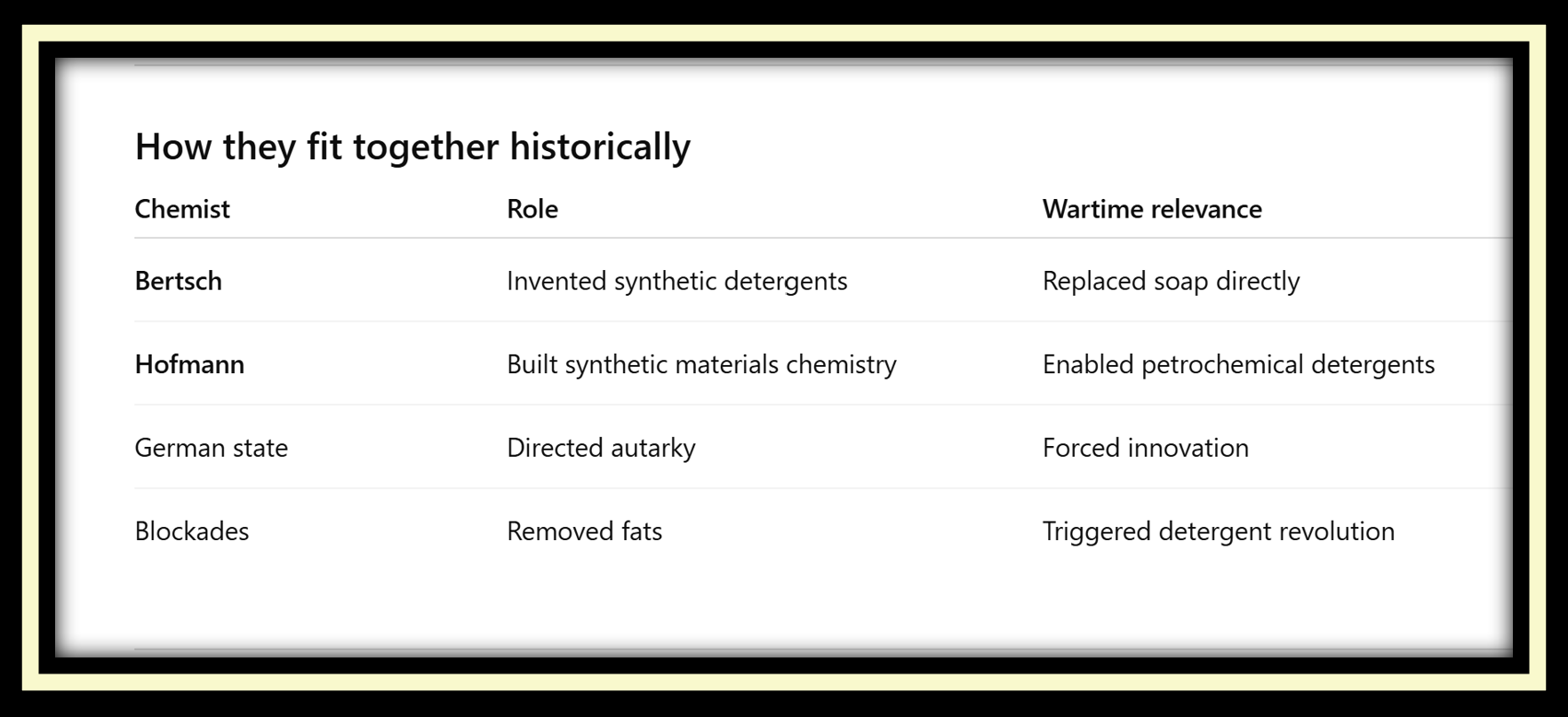
Image AI generated
Conclusion: From Soap Shortages to a Chemical Turning Point
The emergence of synthetic detergents in Germany was not driven by marketing trends or consumer preference, but by a hard chemical reality. When access to fats and oils collapsed during World War I, soap—by definition a product of fat and alkali—could no longer be reliably produced. This exposed a fundamental limitation of traditional soap chemistry and forced a decisive shift toward entirely new cleaning technologies.
That shift reached its practical resolution through the work of Heinrich Gottlob Bertsch. By developing alkyl sulfate–based detergents and introducing FEWA in 1932, Bertsch demonstrated that effective cleansing no longer required triglycerides and could function reliably even in hard water. What began as a response to material scarcity became a permanent transformation in cleaning chemistry, allowing detergents to move from wartime necessity to industrial standard.
Seen together, these developments mark a clear turning point. The transition from soap to synthetic detergents reflects a broader transformation in industrial chemistry—one in which biological raw materials were no longer required for essential daily functions. Synthetic detergents did not replace soap because they were newer or more fashionable; they replaced it because chemistry provided a solution when soap itself could no longer meet the demands placed upon it.
WWI–WWII: The Birth of Synthetic Detergents in Germany
Educational & Informational Disclaimer
The information provided on this website is for educational and informational purposes only. It is intended to share general knowledge about traditional soapmaking, ingredient behavior, historical context, and manufacturing processes.
Nothing on this site is intended to diagnose, treat, cure, or prevent any disease or medical condition. The products offered are classified as soap under FDA guidelines and are not intended to affect the structure or function of the skin or body. Individual experiences and preferences may vary.
Information presented here should not be considered a substitute for professional medical advice, diagnosis, or treatment. If you have a medical condition, skin concern, or sensitivity, please consult a qualified healthcare professional before using any product.
This website may reference or link to third-party scientific, technical, or educational resources for general learning purposes. These references are provided to support transparency and encourage independent research, not as endorsements or medical guidance.
Click here to read the full disclaimer.
Contact me:
Text:
(479) 651-2760
I typically respond to texts almost immediately unless I’m in the middle of making soap.
As soon as I reach a stopping point, I’ll be sure to check and reply.
I check my email daily and will get back to you as soon as possible.