

Showcasing:
Soaps on the curing racks
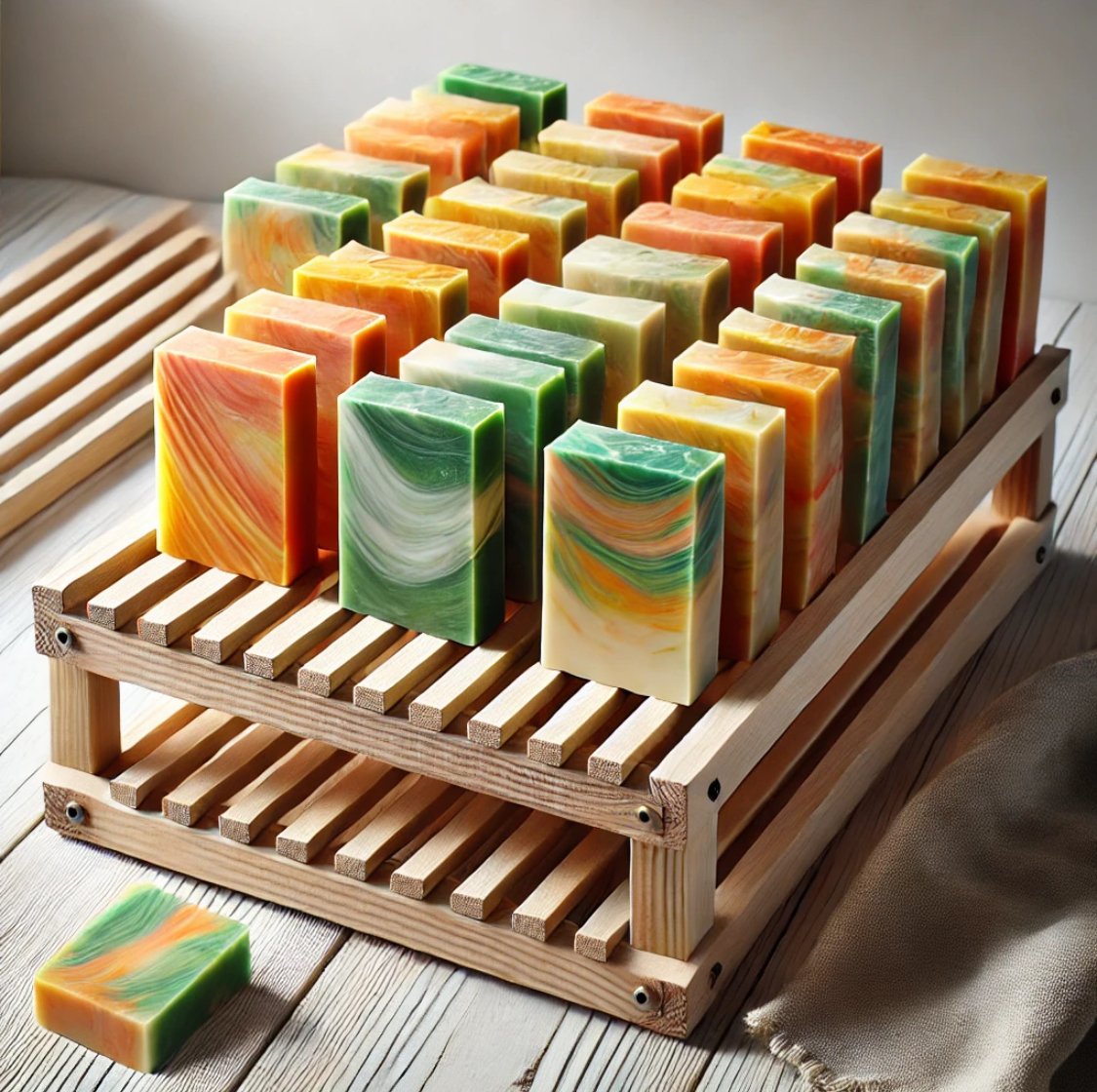
Image AI-generated
The Myth of “Milder” Soap During Curing
One of the most commonly repeated misconceptions in soapmaking is the belief that soap becomes “milder” during curing because it takes weeks for lye to fully saponify the oils. This idea is frequently repeated online and even appears in some soapmaking books. However, this explanation does not align with what is known about the chemistry of soap.
Saponification—the chemical reaction between fats and lye—occurs relatively quickly, typically completing within hours to a day, depending on formulation and conditions. Cure time does not exist to “finish” saponification in properly made soap.
Dr. Kevin M. Dunn and the Science of Soap Curing
Much of our modern understanding of soap chemistry comes from the work of Kevin M. Dunn, author of Scientific Soapmaking. Often regarded as a leading figure in modern soapmaking science, Dr. Dunn conducted extensive research into the physical and chemical changes that occur in soap over time.
Dr. Dunn examined soap crystals using high-powered microscopy throughout the curing process and also documented observations made by his students as they monitored soap over extended periods. These studies consistently showed that the primary and meaningful change during curing is the evaporation of water.
As water content decreases, the soap becomes harder, longer-lasting, and less soluble—but not chemically “milder” in the sense often claimed. The soap’s fundamental chemical structure remains unchanged once saponification is complete.
Why This Distinction Matters
Understanding what curing actually does—and does not do—helps separate tradition from chemistry. Cure time improves the physical properties of soap, such as hardness and longevity, but it does not convert unfinished lye into soap weeks later, nor does it fundamentally alter soap’s chemistry.
This distinction is important for clear, accurate education—and for avoiding the repetition of myths that sound intuitive but aren’t supported by evidence.
What Cure Time Actually Changes in Soap
Once saponification is complete, curing is no longer about chemistry—it is about physical refinement. During cure time, excess water slowly evaporates from the bar, changing how the soap behaves in practical, everyday use.
As water content decreases, the soap becomes:
Harder, allowing it to hold its shape better and resist dissolving too quickly
Longer-lasting, since less water means slower wear during use
More stable in use, producing a lather that is less prone to collapse
Easier to handle and store, with improved firmness and durability
Cure time is therefore a matter of performance and longevity, not chemical transformation. These physical changes are why properly cured soap behaves differently from freshly made soap, even though both are already fully saponified.
Review Policy: I truly appreciate my customers’ honest feedback and am grateful for every review. To keep my website FDA compliant, reviews that include medical, drug, or disease-treatment claims might be edited, shortened, or not published. My products are sold as soap only and are not intended or marketed to diagnose, treat, cure, or prevent any disease or medical condition.
Educational & Informational Disclaimer
The information provided on this website is for educational and informational purposes only. It is intended to share general knowledge about traditional soapmaking, ingredient behavior, historical context, and manufacturing processes.
Nothing on this site is intended to diagnose, treat, cure, or prevent any disease or medical condition. The products offered are classified as soap under FDA guidelines and are not intended to affect the structure or function of the skin or body. Individual experiences and preferences may vary.
Information presented here should not be considered a substitute for professional medical advice, diagnosis, or treatment. If you have a medical condition, skin concern, or sensitivity, please consult a qualified healthcare professional before using any product.
This website may reference or link to third-party scientific, technical, or educational resources for general learning purposes. These references are provided to support transparency and encourage independent research, not as endorsements or medical guidance.
Click here to read the full disclaimer.
Contact me:
Text:
(479) 651-2760
I typically respond to texts almost immediately unless I’m in the middle of making soap.
As soon as I reach a stopping point, I’ll be sure to check and reply.
I check my email daily and will get back to you as soon as possible.