
Combo Bars Explained: What They Are and Why Soap and Detergents Are Combined
What Is a Combo Bar?
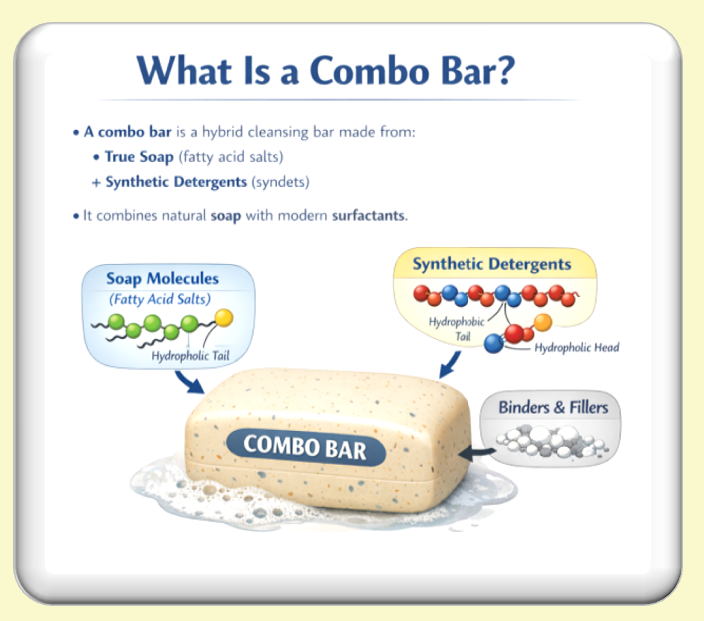
Image AI generated
A combo bar (short for combination bar) is a hybrid cleansing bar made from both true soap and synthetic detergent surfactants that are physically integrated into a single solid bar.
Chemically, it is not one substance, but a composite system.
The Chemistry of a Combo Bar
1. Soap as the Structural Backbone
True soap is made of fatty acid salts formed by saponification (fats or oils reacted with an alkali such as sodium hydroxide).
In a combo bar, soap:
Crystallizes into a solid matrix
Forms a rigid, porous scaffold
Gives the bar shape, hardness, and mechanical strength
Provides familiar soap-like lather and cleansing feel
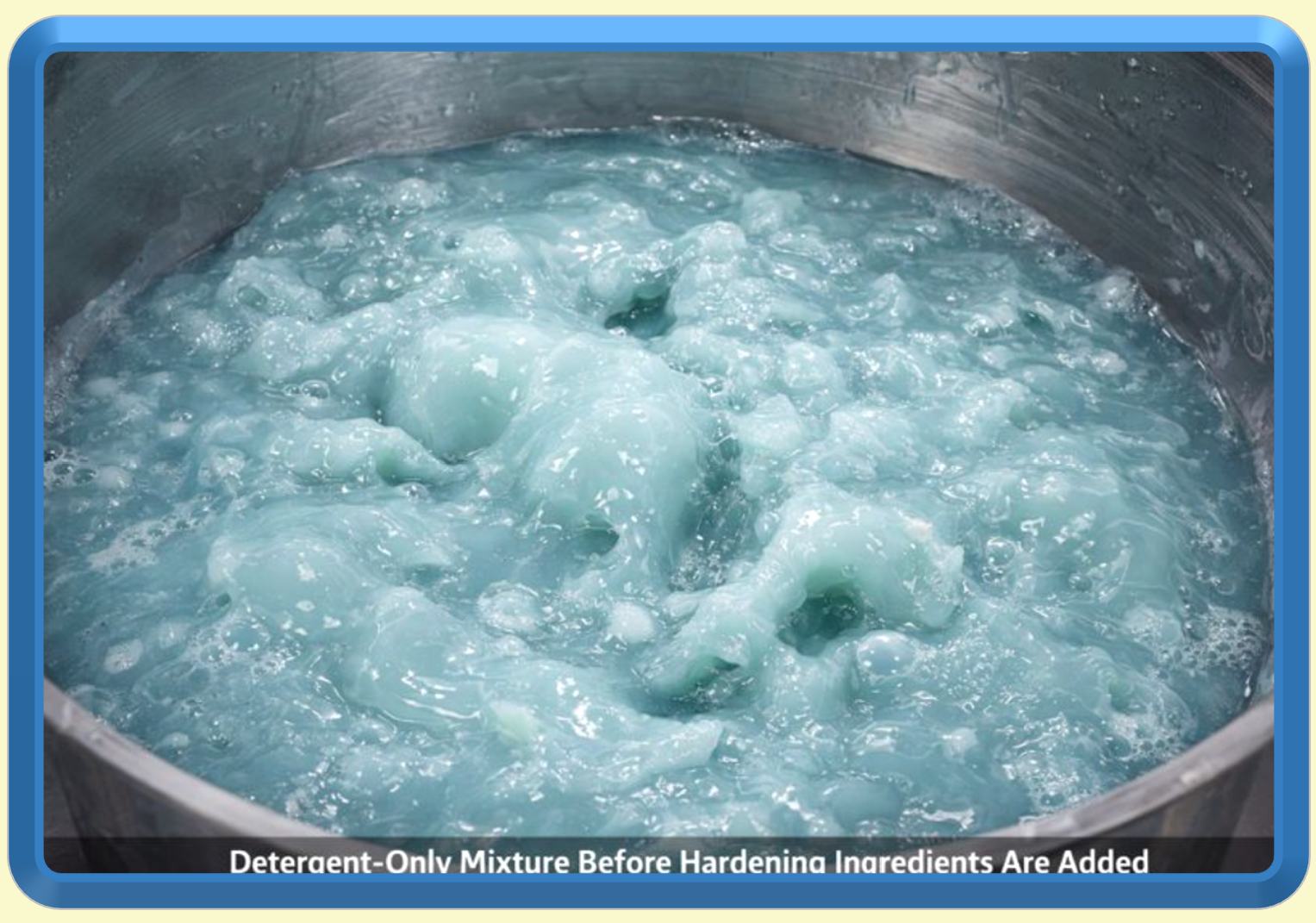
Image AI generated
Most importantly, this soap matrix acts as the physical scaffolding of the bar.
Synthetic detergents do not naturally crystallize into a hard, self-supporting solid. On their own, they are typically powders, pastes, flakes, or soft extrudates. Without soap, a traditional bar shape would collapse, smear, or dissolve too quickly.
Think of soap as the load-bearing framework that makes a traditional bar format possible.
2. Detergents as Performance Enhancer
Synthetic detergents (often called syndets) are surfactant molecules that:
Do not rely on fatty acid salts
Remain effective in hard water
Are more salt-tolerant
Can be engineered for specific cleansing behavior.
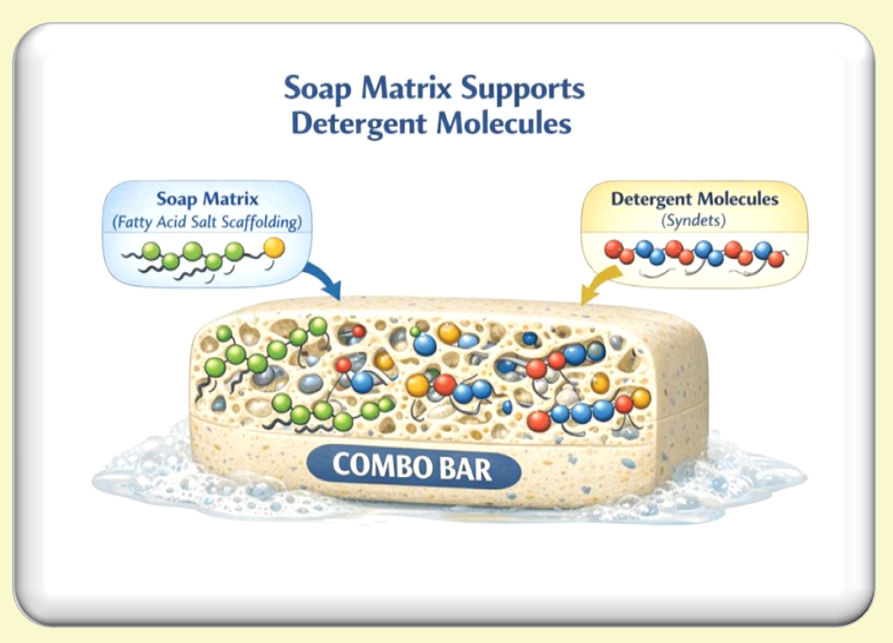
Image AI generated
In a combo bar, detergent molecules:
Have no rigid structure of their own
Are physically supported by the soap matrix
Occupy spaces between soap crystals
Are locked into the bar by the soap’s crystalline framework
Dissolve and activate when water is introduced
The detergents depend on the soap structure to give them hardness, shape, and controlled release.
They are not replacing the soap—they are being carried and stabilized by it.
3. How Soap and Detergents Work Together
When the bar gets wet:
The soap matrix begins to dissolve slowly, maintaining bar integrity
The embedded detergent molecules are released into the wash water
Both types of surfactants participate in cleansing
The detergents help prevent soap scum and performance loss in hard water
The soap provides structure and pacing; the detergents provide performance flexibility.
This hybrid system allows manufacturers to balance tradition and engineering.
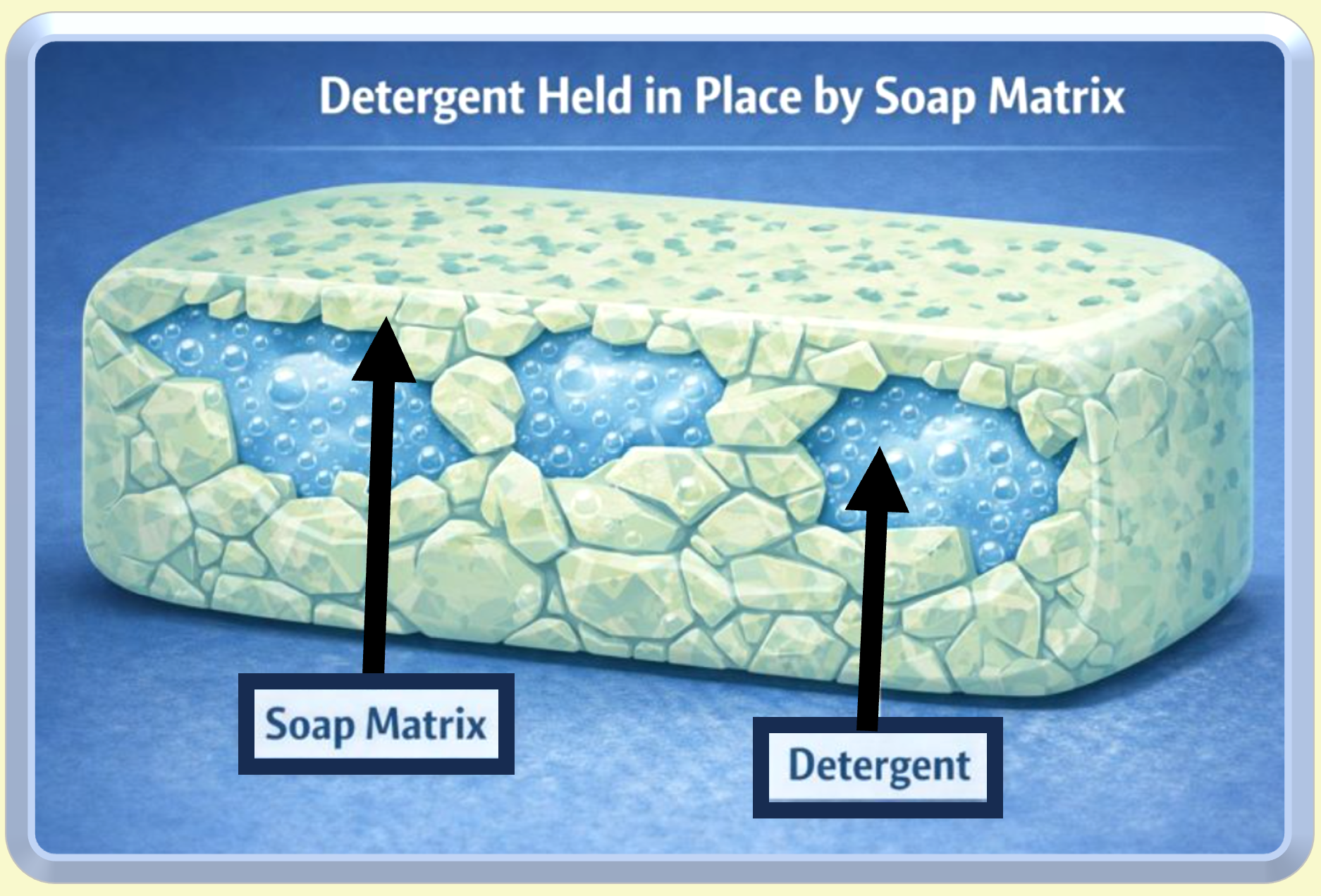
Image AI generated
A combo bar is a hybrid cleansing bar in which true soap forms the rigid structural matrix, providing hardness and shape, while synthetic detergents—unable to form a solid bar on their own—are embedded within the soap scaffold to improve performance and consistency.
4. The Chemical “Scaffolding” Concept
Image AI generated
True soap molecules (fatty acid salts) crystallize as they cool, forming an interlocking lattice. This crystalline structure:
Gives the bar mechanical strength
Locks ingredients in place
Allows extrusion or compression without collapse
Provides shape stability during storage and use
Synthetic detergents do not crystallize this way.
They are typically pastes, powders, or viscous solids that lack internal rigidity.
In combo bars:
Soap forms the rigid backbone
Detergent molecules occupy spaces within that backbone
The bar holds together because of soap, not because of detergent
This is why combo bars can be extruded like soap, while fully syndet bars require entirely different binders.
Why Combo Bars Exist
A combo bar exists because:
Soap alone has limitations (hard water sensitivity, scum formation)
Detergents alone lack the rigid structure needed for a traditional bar
Combining them produces a bar that is solid, durable, economical, and consistent
Chemically speaking, a combo bar is:
A soap-based solid scaffold that gives shape and hardness to the bar while carrying synthetic detergents that enhance cleansing performance.
Why Full Syndet Bars Require Structural Binders
The Core Problem: Detergents Don’t Build a Skeleton
Synthetic detergents (syndets) are excellent surface-active molecules, but they do not crystallize into a rigid, load-bearing solid the way soap does.
Soap molecules:
Self-assemble into ordered crystalline domains
Lock together into a hard, interlocking matrix
Naturally form a bar with shape, strength, and slow wear
Syndet molecules:
Are often amorphous, waxy, or paste-like
Prefer to remain flexible or semi-solid
Collapse, smear, or dissolve too quickly without help
So when soap is removed entirely, the bar loses its natural scaffolding.
What Replaces Soap in a Full Syndet Bar?
To compensate, manufacturers must engineer an artificial structure using non-cleansing binders.
Common syndet bar binders include:
Fatty alcohols (structural waxes)
Stearic acid (as a hardener, not soap)
Starches or cellulose derivatives
Synthetic polymers
Extrusion aids and compaction agents
These ingredients:
Provide shape and hardness
Control dissolution rate
Hold detergent particles together mechanically
Do not participate in cleansing the way soap does
In other words:
Soap builds structure naturally. Syndet bars must be constructed.
This is why full syndet bars are:
Mechanically extruded or compressed
Highly engineered
More formulation-dependent than soap or combo bars
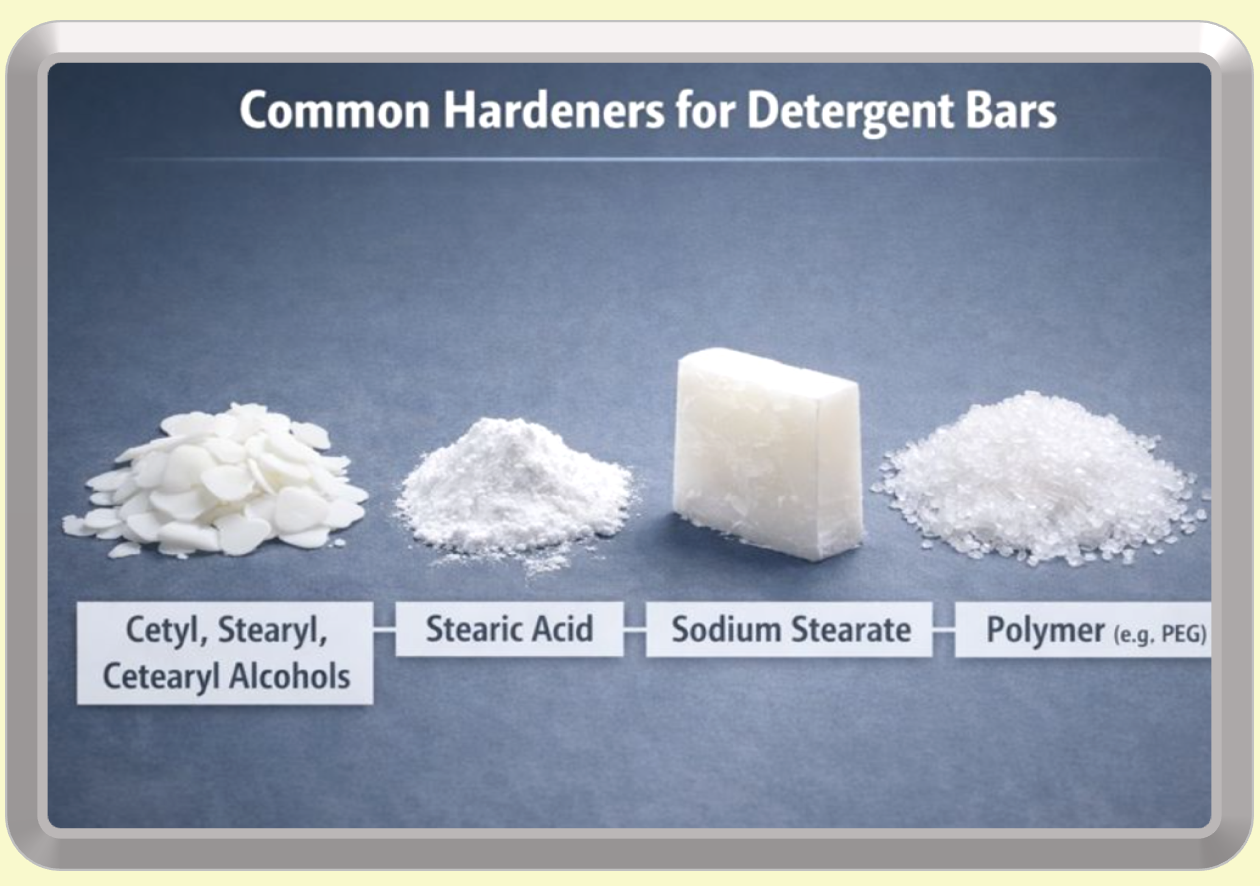
Image AI generated
Glycerin Behavior in Soap, Combo Bars, and Syndet Bars
In True Soap
Glycerin is:
Naturally produced during saponification
A byproduct, not an additive
Fully compatible with soap’s crystal structure
Able to remain in the bar without destabilizing it
In handmade soap, glycerin:
Stays dispersed within the soap matrix
Increases water affinity
Softens the bar slightly
Is structurally tolerated
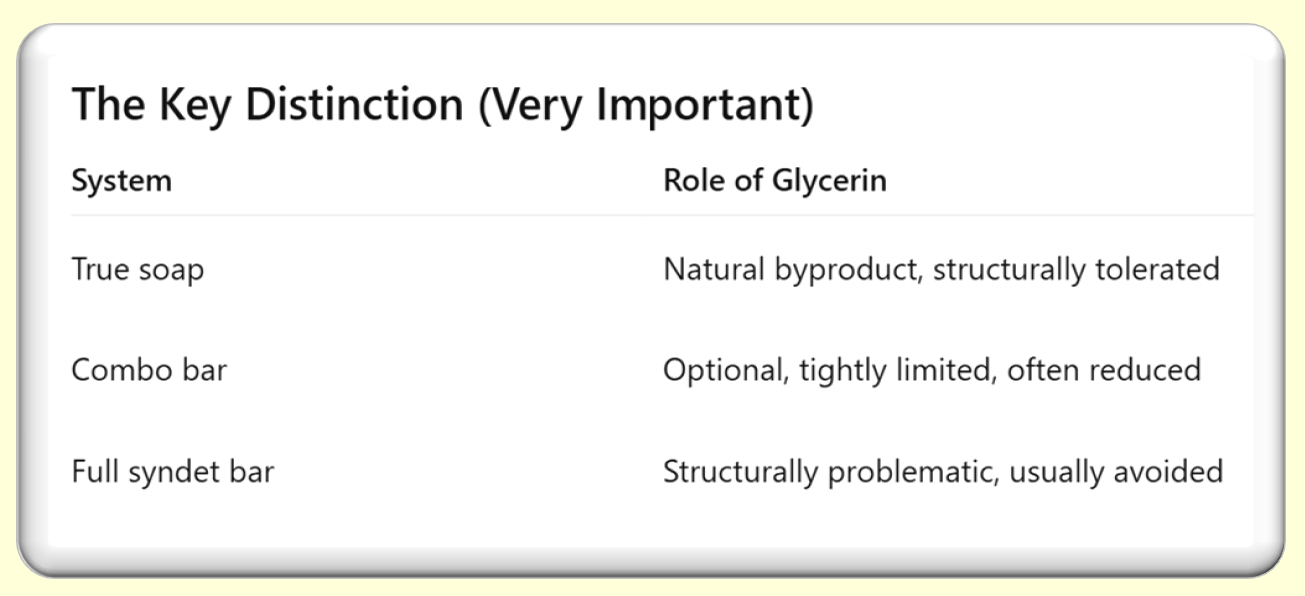
Image AI generated
In Combo Bars
This is where things change.
Combo bars contain:
Soap (crystalline, structured)
Detergents (amorphous, water-hungry)
Glycerin:
Is highly hygroscopic
Strongly attracts water
Competes with detergent molecules for moisture
If too much glycerin is present in a combo bar:
The bar becomes soft or rubbery
Detergents migrate or “weep”
Structural integrity suffers
Shelf stability decreases
So in combo bars:
Glycerin is often reduced, partially removed, or tightly controlled
Not because it isn’t “nice”
But because it interferes with structural balance
This supports your understanding:
Glycerin is not required for cleansing functionality in combo bars, and excess glycerin can actively work against bar stability.
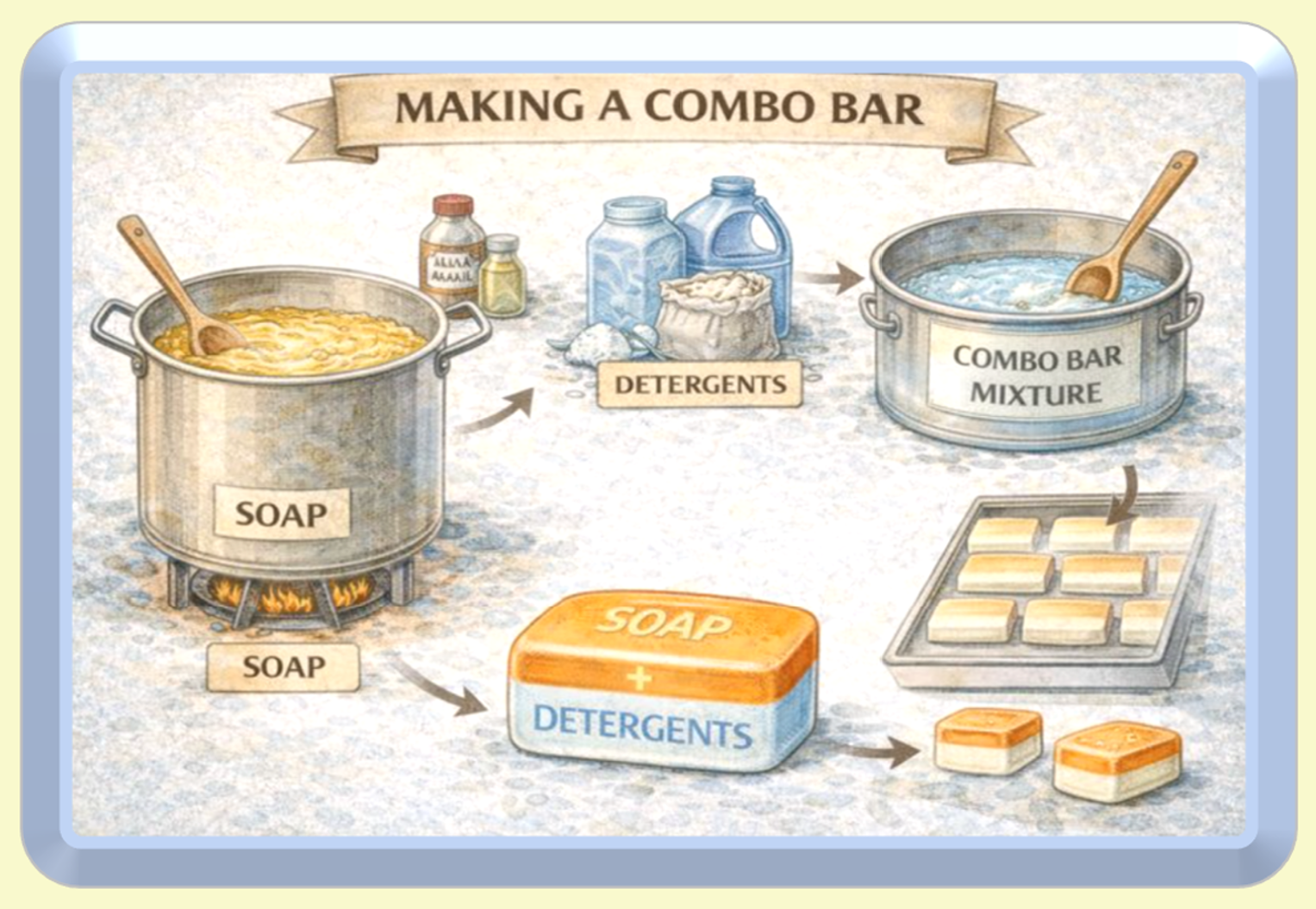
Image AI generated
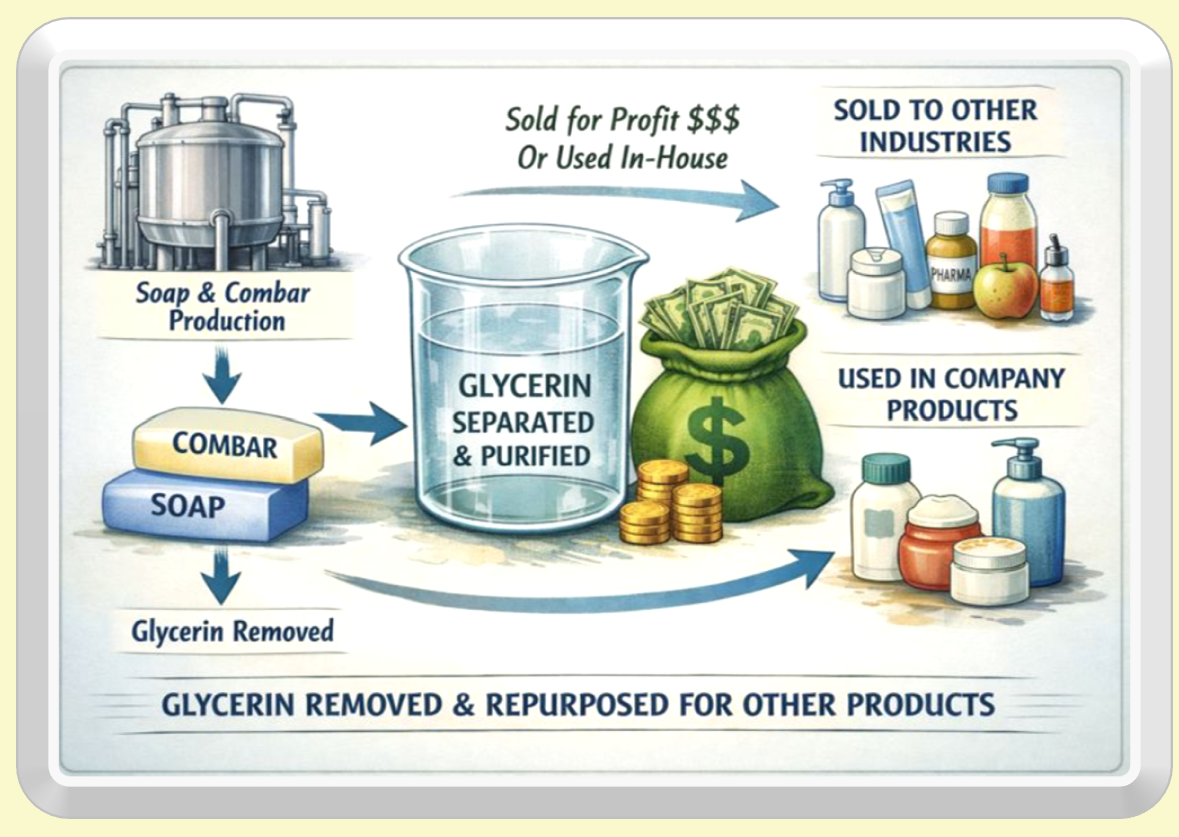
Image AI generated
In Full Syndet Bars
Glycerin behaves differently again.
Because there is no soap crystal matrix, glycerin:
Cannot be “held” structurally
Acts purely as a plasticizer
Softens binders
Increases smearing and deformation
For this reason:
Glycerin is usually minimized or excluded
Or replaced with controlled humectants that behave more predictably
Full syndet bars require entirely different binders because synthetic detergents do not form a rigid, self-supporting solid on their own. Unlike soap, which naturally crystallizes into a hard structural matrix, detergents must be mechanically held together using waxes, fatty alcohols, or polymers. In these engineered systems, glycerin—while beneficial in true soap—is often reduced or removed because its strong attraction to water softens the bar, disrupts structure, and offers no functional necessity for cleansing.
Conclusion: Structure Determines Everything
Combo bars exist because soap and synthetic detergents solve different problems—and neither can fully replace the other on its own. Soap naturally forms a rigid, self-supporting crystalline matrix that gives a bar its shape, hardness, and controlled wear. Synthetic detergents, while highly versatile and effective cleansers, lack this inherent structure and must either be carried by soap or mechanically engineered into shape using binders and extrusion systems.
In a combo bar, soap serves as the load-bearing framework, physically supporting detergent molecules that enhance performance in hard water and improve consistency. In full syndet bars, that natural scaffolding is absent, requiring manufacturers to construct an entirely artificial structure from waxes, fatty alcohols, polymers, and compaction aids.
Glycerin’s role follows this same structural logic. In true soap, glycerin is naturally compatible with the crystalline matrix and can remain without destabilizing the bar. In combo bars, glycerin must be carefully controlled to avoid softening and structural imbalance. In full syndet bars, it offers no structural benefit at all and is often reduced or removed entirely.
Ultimately, the differences between soap, combo bars, and full syndet bars are not philosophical or marketing-driven—they are dictated by chemistry and physical structure. Understanding how these materials behave explains why these bars are formulated differently, why certain ingredients are included or excluded, and why no single cleansing bar can behave exactly like another.
If you arrived here from one of my soap pages and would like to read the full story of how synthetic detergent cleansers evolved during the 20th century, click the button to begin at the start of this series.
Educational & Informational Disclaimer
The information provided on this website is for educational and informational purposes only. It is intended to share general knowledge about traditional soapmaking, ingredient behavior, historical context, and manufacturing processes.
Nothing on this site is intended to diagnose, treat, cure, or prevent any disease or medical condition. The products offered are classified as soap under FDA guidelines and are not intended to affect the structure or function of the skin or body. Individual experiences and preferences may vary.
Information presented here should not be considered a substitute for professional medical advice, diagnosis, or treatment. If you have a medical condition, skin concern, or sensitivity, please consult a qualified healthcare professional before using any product.
This website may reference or link to third-party scientific, technical, or educational resources for general learning purposes. These references are provided to support transparency and encourage independent research, not as endorsements or medical guidance.
Click here to read the full disclaimer.
Contact me:
Text:
(479) 651-2760
I typically respond to texts almost immediately unless I’m in the middle of making soap.
As soon as I reach a stopping point, I’ll be sure to check and reply.
I check my email daily and will get back to you as soon as possible.